 |
| He might have had a point. |
Saturday, October 29, 2011
Cute Things Kids Say: Dead Butterflies
Child: (Upon looking at the dead butterflies pinned up in the library in the Visitor's Center) They don't look much different than the live ones do.


Sunday, October 23, 2011
Pink Spinx
About 2 weeks ago I found a caterpillar lying near the edge of our garage. Judging by its position, it may have been stung by a wasp or hornet. At any rate, I identified it as a Hydrangea Spinx caterpillar, which can vary in color. The one I found was a lovely shade of pink, but they also can be green.


Tuesday, October 18, 2011
Buckeyes (Again)
A few entries ago, I mentioned finding a Buckeye Caterpillar and that I'd post when it hatched. Well, it hatched a few days ago. Pictures!


Sunday, October 9, 2011
Being Stung Really Smarts (Get it? Anyone?)
A few days ago, I found this guy outside on a plant.

It's called a Smartweed Caterpillar (also known as a Smeared Dagger Moth Caterpillar), and it's known for having quite the nasty sting to it. It's not the only stinging Caterpillar, but it is one of the more common. They'll eat strawberry, grasses, corn, clover, and Smartweed (duh).
I found one on our strawberry plants last year. Note that these caterpillars are variable in color: the one I found this year was black with yellow stripes, while the one on the strawberry was red with yellow spots.

Thankfully I didn't get stung either time. It's not that I knew what kind of caterpillar they were. Instead, there are certain steps to taking an educated guess as to whether or not the caterpillar is poisonous.

It's called a Smartweed Caterpillar (also known as a Smeared Dagger Moth Caterpillar), and it's known for having quite the nasty sting to it. It's not the only stinging Caterpillar, but it is one of the more common. They'll eat strawberry, grasses, corn, clover, and Smartweed (duh).
 |
| FEAR ME. |
I found one on our strawberry plants last year. Note that these caterpillars are variable in color: the one I found this year was black with yellow stripes, while the one on the strawberry was red with yellow spots.
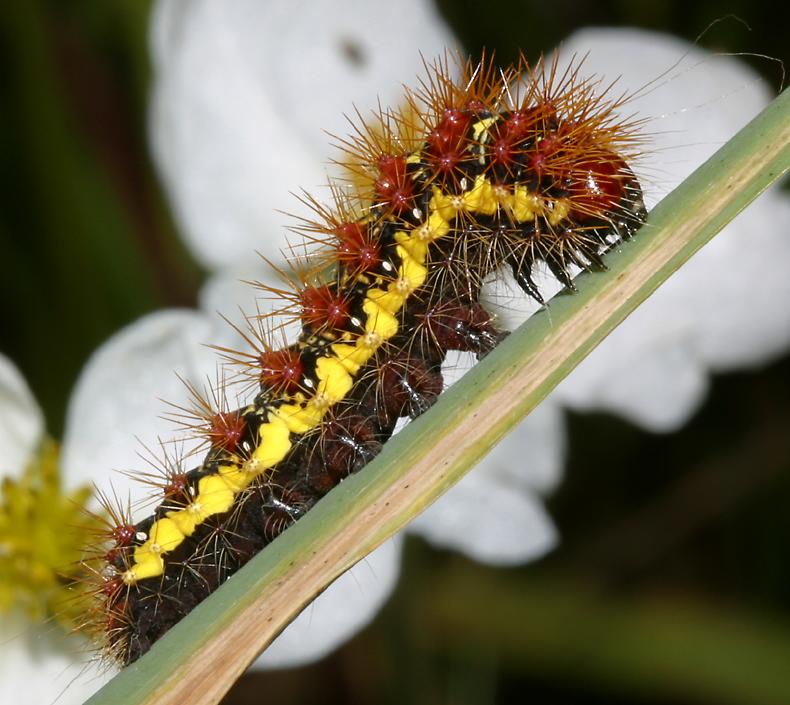
Thankfully I didn't get stung either time. It's not that I knew what kind of caterpillar they were. Instead, there are certain steps to taking an educated guess as to whether or not the caterpillar is poisonous.
- AVOID ANYTHING THAT'S YELLOW, RED OR BOTH. These are warning colors for most animals. Ones that are both yellow and red have a better chance of being poisonous.
- AVOID ANYTHING WITH SPINES. Spines are often how caterpillars deliver poison. Hairs can also cause irritation.
- AVOID ANY BIZARRE CATERPILLARS. By bizarre, I mean any caterpillars with bright colors or strange body shapes. These are often poisonous too.
 |
| Avoid this like the plague. |
Sunday, October 2, 2011
Buckeyes! (The butterfly, not the nut)
The other day I found a Buckeye caterpillar crawling across a parking lot. (Buckeye caterpillars can be identified by their spines and the orange markings across their sides). I brought it home and it almost immediately began to hang in a J-form.

The next day, it had chrysalised.
 | |
| Bad picture focus ahoy! |
The chrysalis will probably overwinter. I'll post when it does hatch.
Sunday, September 18, 2011
From a Volenteers Eyes
So, now that we’re on our seventh entry on the blog, you guys may be asking yourselves, “What’s it like volunteering at the Butterfly House? When did it first open? How long has the Flight Attendant been there?” If so, you’re either simply curious or you’re a stalker.
 |
| Don't make me use this. |
- Arrive at Butterfly House
- Previous volunteer leaves
- Start shift – check to make sure that there are plenty of sugar sticks and that the microscopes and monitors are focused
- Close up - Closing up involves turning off the water valves and fans, closing the caterpillar containers, changing the ‘Open’ sign to closed, locking up, and bringing the tickets up to the Visitor’s center. Opening up in the morning appears to be similar to closing up, but I’ve never worked a morning shift so I can’t be sure.
 |
| Pictured: Me at 10:00 in the morning |
Speaking of which, there are several things we volunteers try to do to assist the visitors.
- Introduce people if they haven’t been here before and remind them to turn in their tickets.
- Help with identifying butterflies, chrysalises, caterpillars, plants and anything else they may have questions about.
- Show people the best way to get a butterfly on a sugar stick.
- Answer any questions they may have about Beech Creek or the house itself.
- Remind people not to step up on the bricks or in the gardens.
Occasionally we will also try to capture butterflies that come to our gardens to place inside the house. One of us will go outside for a few minutes and bring whatever they catch inside. We aren’t very picky, but there are some species we favor over others. Any skippers (save for Silver Spotteds) are usually kept outside, as are Monarchs (due to disease and the overabundance of them we have in the house). We also will not usually bring in a species that we don’t have in the House already due to them not being able to breed.
I hope you've enjoyed this little insight. And if you didn't, please remember that I know where you live.
I hope you've enjoyed this little insight. And if you didn't, please remember that I know where you live.
 |
| Seriously. |
Sunday, September 11, 2011
Monarch Caterpillar Defense
When threatened, Monarch caterpillars will curl up into a ball to hide from predators. Even when they're almost ready to chrysalis.
 | |
| "They can't see you if you don't move!" "That's T. Rexs." "Oh." |
Subscribe to:
Posts (Atom)